Social skills, taught where friendships actually happen
Friendship runs on a hundred tiny skills nobody teaches on purpose. How to join a game that’s already started. How to lose one without leaving it. How to tell when a friend is done talking. Many children with autism want connection and simply haven’t been given a reliable way in. That’s teachable. Honestly, it’s our favorite thing to teach.



Services designed and led by Oak & Arrow’s Board Certified Behavior Analysts: Paige Tully, BCBA #1-20-44228, CT license BA.001021, and Tiffany Salvatore, BCBA #1-25-81796, CT license BA.001840. Both came to behavior analysis from the classroom.
When parents reach out about social skills
- Wants friends but can’t seem to make them stick.
- Plays next to kids, not with them.
- Conversations that are one-way tours of a favorite topic.
- Recess and birthday parties end in tears or in a corner.
- Group projects and team games feel impossible.
If a few of these sound like your kid, this is the work.

What this looks like in practice
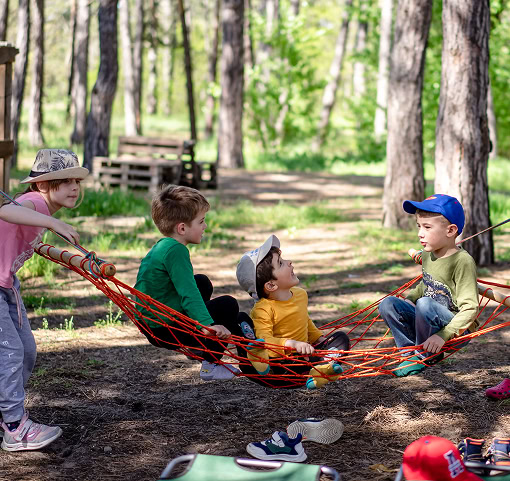
We break big social moments into small learnable pieces and practice them where they’ll get used. That might mean rehearsing how to ask a cousin to trade snacks before the cousins arrive, running a board game where losing gracefully is the actual goal, or scripting and practicing the first thirty seconds of joining kids at the park. Between Paige’s years in elementary and middle schools and Tiffany’s decade teaching special education, we’ve watched a lot of recesses from the inside, and we know exactly which moments trip kids up.
Then we work on the part most programs skip: making it stick with real peers. Siblings are drafted. Playdates become practice fields, with you coached on when to help and when to sit on your hands. The goal is never to script your child into someone else. It’s to hand them the moves so their own personality can land.
Your part in it
You’ll learn what we’re building and how to spot the practice moments hiding in a normal week: the pizza order, the checkout line, the cousin visit. Parents are usually surprised how many reps a Tuesday contains once you know what to look for.
Questions Parents Ask
Not by itself. Alone time isn’t a deficit, and we don’t treat preferences as problems. What we work on is capability: making sure that when your child wants to join, they can. Wanting to is theirs to decide.
We hope to have a clinic in the future, but currently we are working with children in their homes with siblings/other family members. We will work on scenarios/role play. With prior approval we can go to daycares/other community settings to increase independence and social skills.
Early practice always looks a little rehearsed, the same way early piano sounds like scales. Fluency comes with reps in real settings, which is exactly why we practice there.
Honest answer: it varies with the child and the goal, and we won’t pretend otherwise. Many families notice the first real moments within weeks of consistent practice. We measure it, so you’ll see what we see.
More of what we work on
Functional Communication
Helping your child ask for what they need, in words, signs, or pictures. For many kids this is where everything else starts.
Behavior Support
Aggression, bolting, transitions that run the house. Every behavior is doing a job for your child. We find the job, then teach a safer, easier way to get it done.
Executive Functioning
Routines, transitions, starting and finishing things. The skills that make school days and mornings work.
Daily Living Skills
Dressing, brushing teeth, washing hands, cleaning up. Everyday routines, taught step by step until your child can run them on their own.
Parent Collaboration
You’re part of every session, because the plan only works if it keeps working after I leave. Teaching you is part of the job.
Something else going on?
Most of what families bring me doesn’t fit neatly in a box, and the assessment is where we find out what actually helps.
Start with the interest form
Tell me a little about what’s going on. You’ll hear back from me, not an intake department, within 24 business hours.
Interest Form
Stay in the loop
Oak & Arrow will never share or sell your email.